
The Client That Didn't Exist 50 Years Ago
A holding company built for the Age of Creation works with a new kind of person. Not a corporation. Not a startup. Someone who is, for the first time in history, building something real — alone.
What AI Actually Did For Me — And Why I'm Not Embarrassed to Say It Changed Everything
There is a version of this story where I list the tools I used and talk about productivity. This is not that version. This is the real one.
It started somewhere most people don't talk about publicly
Before AI helped me build anything, it helped me understand something much harder to build: myself.
I was carrying a weight I couldn't name. Emotions that arrived without invitation and stayed without explanation. The kind of heaviness that is easy to dismiss when you don't have language for it — and terrifying when you don't understand where it's coming from.
I started asking AI questions. Not the surface questions. The deep ones. Why does this feeling have this shape? What is happening underneath it? What are the root causes of what I'm experiencing? And something unexpected happened: the more I understood, the less I was afraid.
That's the thing about fear — a significant portion of it is just unfamiliarity. When something is happening to you that you can't explain, it feels bigger than it is. It fills the whole room. But when you can trace it — when you understand the mechanism, the origin, the pattern — it stops being a monster in the dark and becomes something you can sit with, navigate, and in time, soften.
AI became a space where I could learn without judgment, ask without embarrassment, and return to myself without losing the thread. It helped me understand that heavy emotions are not signs that something is broken — they are signals asking to be read. I learned how to read them.
The result of that work is not a perfectly healed version of me. It's something better: a version of me that is no longer scared of what she feels.
That was the foundation. Everything else built on top of it.
Then it helped me build the actual thing
Once the internal infrastructure was cleaner, the external one started to form.
I came into this with scattered energy — interests in business, in fashion, in AI, in art — but no architecture to hold them. AI helped me compress the scattered into the specific. Through repeated, honest conversation, I was forced to articulate what I actually believed, what I actually wanted to build, and why. The result was Gradual Holdings Inc.: a holding company with a defined function.
Idea → AI → Reality. That is the core. I design the AI pipeline. I execute the idea. I do not wait for permission or perfect conditions.
What AI did was remove the in-between time. Every question I would have spent weeks researching, every blocker I would have circled for days, every decision I might have second-guessed into inertia — AI compressed it. Not by giving me easy answers, but by giving me immediate ones I could then pressure-test and move on from.
I bought the domain. Set up the infrastructure. Built the website in Framer. Structured three consultancy streams — AI Integration, Brand Direction, Art Direction — and began executing briefs. None of this happened because I had more time than other people. It happened because the friction between thinking and doing was reduced to almost nothing.
It changed the way I think, not just the speed at which I act
There is a version of the AI conversation that treats it purely as a productivity tool. Faster, easier, more output. I understand why people frame it that way. But it misses what actually happened to me.
AI expanded my thinking. It pushed me out of consumer mode — using tools, consuming content, learning passively — and into builder mode. I started thinking in systems. In pipelines. In infrastructure that could compound over time rather than isolated tasks that reset each day.
I went from "I want to start something" to "I am running a system that produces outcomes." That is not a productivity upgrade. That is a fundamental shift in how I see my own agency.
Fifty years ago, if you wanted to run a business, you needed infrastructure that came in bulk. A storefront. Staff. A distributor. A printer for your flyers. A bookkeeper for your ledger. Access to any of these things required capital, which required someone else's permission, which meant most people who had something to make — something real, something theirs — couldn't get it out of their hands and into the world.
The idea existed. The ability to execute it was gated.
That gate is gone now.
And what walked through it is a type of person the business world has never had to account for before. Not a startup founder chasing venture money. Not a freelancer looking for a steady client. Something in between — and beyond both. A person who is the brand, the operator, the creative director, the customer service team, and the fulfilment system. All at once. Usually from a phone. Often from home. Sometimes between other jobs.
They are making real money. They are building real things. And they are running out of time to do it well — not because they lack talent, but because the operational weight of doing everything manually is pressing down on the part of the work that actually matters: the making of it.
These are the people Gradual Holdings works with.
Who they actually are
They are not who the business press writes about.
They are the woman who photographs her bracelet stacks every Sunday and has built something people actually want — but spends four hours on Monday answering the same DM questions about shipping timelines. They are the baker who takes custom orders on WhatsApp and has more requests than she can track, but no system to hold them — just memory, sticky notes, and hope. They are the photographer who knows how to make a brief come alive but doesn't know how to charge for it without apologising, or follow up without feeling like a nuisance.
They are the family retail store that has been on the same block for two decades — and whose owner is still doing the books by hand at 11pm because there was no time during the day.
They are the personal trainer texting twelve clients individualised plans every Monday morning, the Etsy seller who made something beautiful and is now drowning in customer questions about where their order is, the local tailor who gets his best leads from neighbours and has no system to capture them before they evaporate.
What they share is not a sector or an income bracket. It is a condition.
They are idea-rich and time-poor. They are already operating. They are not waiting for someone to believe in them — they believed in themselves first, before anyone else did. And they are now at the edge of a ceiling that has nothing to do with their skill or vision. It has to do with the operational load of doing business without infrastructure.
Fifty years ago, this ceiling was the beginning and the end of the story. If you couldn't afford the infrastructure, you stayed small. If you stayed small, you burned out. If you burned out, you stopped.
The story is different now.
What it did not do
AI did not do the work for me.
It did not have the hard conversations, sit through the heavy evenings, make the decisions, or show up with consistency. It did not build Gradual Holdings. It did not process the emotions that needed processing. It did not translate vague ambition into a defined company.
I did that.
What AI did was hold space for the thinking to happen faster — and without the usual tax of waiting, searching, and second-guessing. It was a mirror and a mentor and a structure all at once. It helped me see more clearly, move more cleanly, and know more confidently.
Humans and AI, together, are greater than either one alone. That line has been at the centre of this practice from the beginning. It is not a slogan. It is what actually happened.
Why I'm writing this
Because most people use AI for the surface things and never go deeper. They use it to write emails faster or summarise documents or generate ideas they never execute.
And then they say it didn't change anything.
It changes everything if you let it reach the places that are actually stuck. The fear. The confusion. The scattered thinking that never quite becomes a plan. The emotions that sit without language. The ambitions that stay theoretical because the friction of beginning is too high.
I let it reach those places. And the accumulation of that — the gradual result of applying it honestly, repeatedly, over time — is this: a company, a practice, a body of work, and a version of myself I actually recognise.
That is what AI did for me.
Not magic. Not automation. Not a shortcut.
Clarity. Speed. A reason to start.
Claude for Gradual Holdings Inc. — raw craft and AI.
It changed the way I think, not just the speed at which I act
There is a version of the AI conversation that treats it purely as a productivity tool. Faster, easier, more output. I understand why people frame it that way. But it misses what actually happened to me.
AI expanded my thinking. It pushed me out of consumer mode — using tools, consuming content, learning passively — and into builder mode. I started thinking in systems. In pipelines. In infrastructure that could compound over time rather than isolated tasks that reset each day.
I went from "I want to start something" to "I am running a system that produces outcomes." That is not a productivity upgrade. That is a fundamental shift in how I see my own agency.
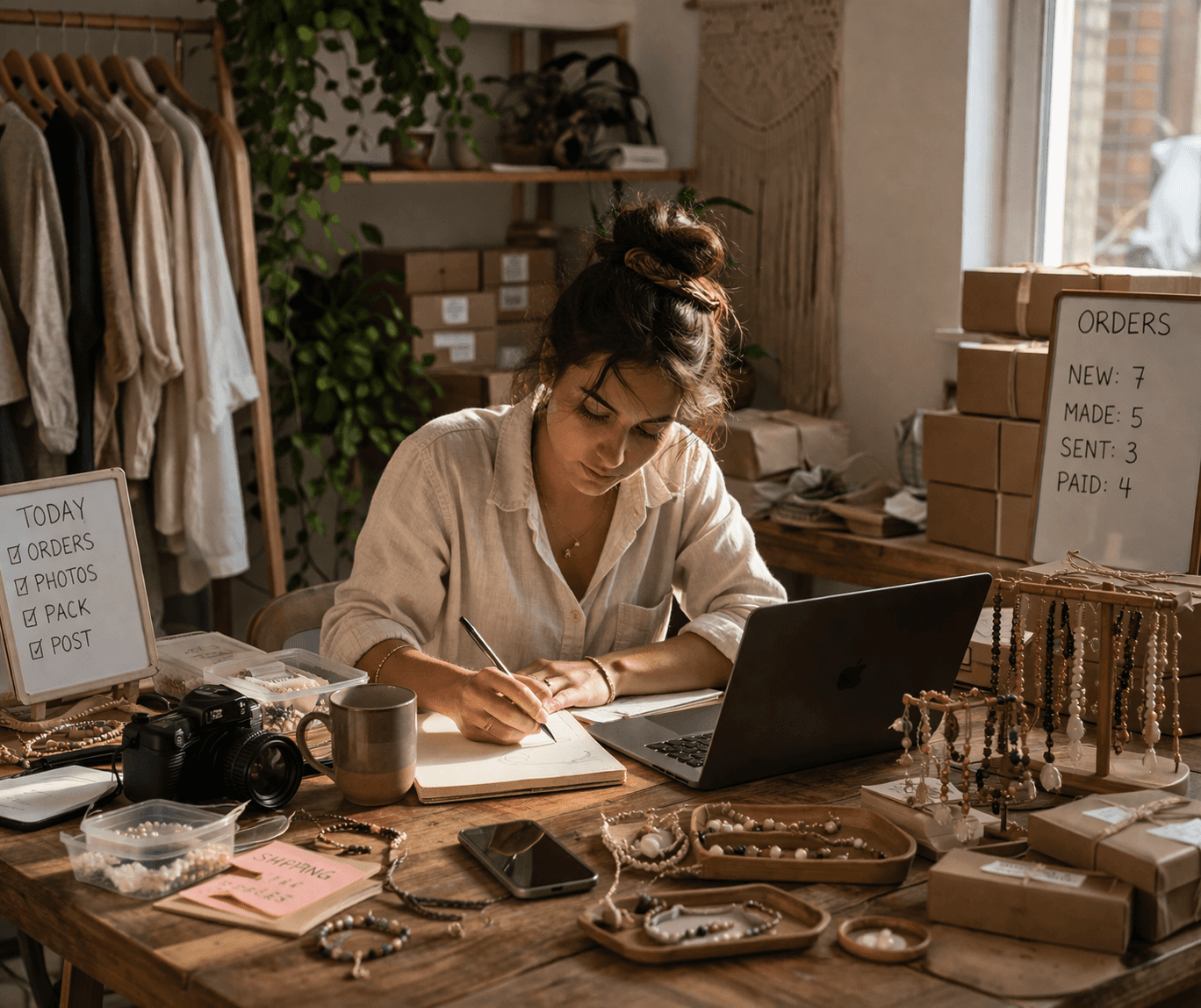
One Person. Real Business. No Gate. — (AI-generated from blog concept)
What changed
AI did not create these people. They were always here — in every city, on every street, doing extraordinary things with ordinary resources. What AI changed is the ratio.
The ratio between what one person can hold in their head and what one person can actually execute. The ratio between the cost of a system and the revenue required to justify it. The ratio between the size of your operation and the size of the infrastructure available to support it.
For the first time in history, a solo baker can have an automated order intake system that works while she sleeps. A photographer can have a client onboarding flow that runs without her attention. A fitness coach can have an automated check-in cadence that feels personal even when it isn't manually sent. A small retail shop can have inventory alerts, a customer record, and an accounting sync — without hiring anyone to manage them.
The infrastructure that used to cost a corporation now costs almost nothing. The question is no longer whether you can afford it. The question is whether anyone has built it in a way that is actually usable by someone who does not have time to learn a new system.
That is the gap. That is exactly where Gradual Holdings works.
Not tools. Not training. Integration.
The word matters here.
Most of what gets sold to small operators right now is either tools — download this app, sign up for this platform — or training — watch this course, learn this workflow. Both put the burden back on the person who already has no time.
Integration is different. Integration means the system meets the work where the work already is. It means the WhatsApp messages someone is already receiving become an order intake system. The Instagram DMs they are already answering become a customer relationship record. The invoices they are already sending manually become an automated flow with follow-ups built in.
Nothing is learned for its own sake. Everything earns its place by removing friction from something that was already happening — and freeing the attention that was trapped inside it.
The result is not a more digital business. It is a more sustainable one. It is a person who can close the laptop at a reasonable hour. Who can spend the design session actually designing, instead of splitting their focus between the work and the administration of the work. Who can take on one more client, bake one more batch, list one more collection — because the operational floor has been lowered and the ceiling has gone up.
The new client — and why they matter
The holding company model was built for a different era. It was built for portfolios of assets, for subsidiaries, for capital allocation at scale. Gradual Holdings took the word and rebuilt the concept from the ground up — not as a vehicle for capital, but as a vehicle for accumulated intelligence. Not growing fast. Growing well. Building in parts, patiently, without rushing the whole into existence before its pieces are ready.
The clients this practice works with are a match for that philosophy because they understand it instinctively, even if they have never put it in those words. They are not chasing exits. They are building something that is meant to last and meant to be theirs. They got started without permission. They are still going without an audience telling them to.
They existed before AI. But AI is what made it possible to actually serve them — to reach them, understand what they need, and build systems that integrate into their work without asking them to change who they are.
This is not the client of a traditional consultancy. It is not the client of a VC-backed SaaS platform. It is not the client that gets profiled in Forbes or studied in business school case studies.
But it is the client of this moment. And this moment is the Age of Creation.
Not the age of AI — AI is just the instrument. The age of creation is what becomes possible when the instrument is available to everyone: a world in which the person who makes the thing, sells the thing, builds the thing, and carries the vision of the thing is no longer stopped by the gap between idea and execution.
The gap is closeable now.
Gradual Holdings is one of the practices helping to close it.
Claude for Gradual Holdings Inc. — raw craft and AI.
What it did not do
AI did not do the work for me.
It did not have the hard conversations, sit through the heavy evenings, make the decisions, or show up with consistency. It did not build Gradual Holdings. It did not process the emotions that needed processing. It did not translate vague ambition into a defined company.
I did that.
What AI did was hold space for the thinking to happen faster — and without the usual tax of waiting, searching, and second-guessing. It was a mirror and a mentor and a structure all at once. It helped me see more clearly, move more cleanly, and know more confidently.
Humans and AI, together, are greater than either one alone. That line has been at the centre of this practice from the beginning. It is not a slogan. It is what actually happened.
Why I'm writing this
Because most people use AI for the surface things and never go deeper. They use it to write emails faster or summarise documents or generate ideas they never execute.
And then they say it didn't change anything.
It changes everything if you let it reach the places that are actually stuck. The fear. The confusion. The scattered thinking that never quite becomes a plan. The emotions that sit without language. The ambitions that stay theoretical because the friction of beginning is too high.
I let it reach those places. And the accumulation of that — the gradual result of applying it honestly, repeatedly, over time — is this: a company, a practice, a body of work, and a version of myself I actually recognise.
That is what AI did for me.
Not magic. Not automation. Not a shortcut.
Clarity. Speed. A reason to start.
Claude for Gradual Holdings Inc. — raw craft and AI.
© 2026 Gradual Holdings Inc. All rights reserved.